
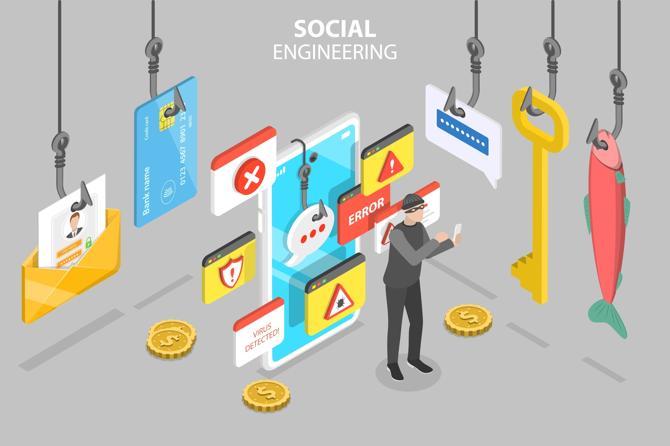

We usually associate hackers with specialists in software that infiltrates our devices and wreaks havoc. However, practice shows that the ability to exploit human emotions and common cognitive errors is just as effective as creating lines of code. Socio-technical attacks are precisely about clever manipulation aimed at getting the user to take a specific action. Learn about hackers’ methods and defend yourself effectively against them!
Phishing
This is the most common type of social engineering attack, as well as hacking attacks in general. The user receives an email in which the sender impersonates others, asking for access data or to log in to, for example, online banking. After clicking on the indicated link, victims are redirected to a page that looks identical to the website of a well-known institution or bank. When logging in, the user unknowingly provides the hackers with access data to the chosen system. Phishing is often a mass action, as criminals take email addresses from stolen databases in order to send spam to them. If there are thousands of them, statistically speaking, some percentage of users may perform the action desired by the hackers.
- How to protect yourself?
Above all, do not click on suspicious links. Pay attention to whether the website you go to is secured with an SSL certificate, which assigns the domain to its specific company. If you have a website yourself, you can also protect your customers from phishing. To do this, you should use an SSL certificate and choose a domain provider that offers DNSSEC security for them. It is a cryptographic mechanism that authenticates DNS queries, which protects domains registered in the Secure Domain package in Vader Design.
Spear phishing
Spear is a variant of phishing targeting selected users. It is usually used to attack a specific organization. A victim of spear phishing receives an email in which the sender impersonates a person from the company or a contractor. The email asks the user to provide relevant data. Once the user does so, the hacker gains access, e.g. to the organization’s IT system or the attacked person’s email inbox, and can thus gain valuable information. Spear phishing can also be used to install malware. To do this, the hacker sends the user a message with an attachment, such as an invoice or a delivery note, and a request to open it urgently. When the attachment is clicked, a virus is installed on the victim’s computer.
- How to protect yourself
Spear phishing exploits the human tendency to trust. Any message with an attachment is always worth approaching with caution. Above all, pay attention to the sender’s email address and the signature and footer of the message. If they look out of place, this is a warning signal for you. The same goes for any linguistic clumsiness. If you notice that a message looks suspiciously unusual, the best thing to do is to call the sender and ask whether he or she has actually sent you such an e-mail.
Baiting
 The term ‘baiting’ means ‘dropping the bait’. It is a method used to attack organizations selected by hackers and requires the physical presence of the criminal in the company, such as in common areas. Most commonly, baiting involves planting a data carrier, such as a memory stick with a company logo on it, with malware. It is sometimes labelled in a way that encourages its activation (sometimes it is a “payroll”, so that the employee could find out what other employees are paid). The method also takes the form online of sending the user a particularly tempting offer. To take advantage of it, valuable data must be provided or the software must be run. In both cases, hackers prey on people’s curiosity or even greed.
- How to protect yourself?
As with any type of cyber attack, awareness of the threat is key. You must remember not to use any abandoned media. If you wish to do so, scan such media with an anti-virus programme, on a computer other than your company’s. To protect yourself from the online version of baiting, approach suspiciously attractive offers you receive by e-mail with caution. It is also imperative that you do not give out your online banking login details or credit card details on any site.
Vishing
A vishing attack is another variation of phishing carried out over the telephone, often using VoIP channels such as Skype. These types of systems allow hackers to impersonate another caller. Criminals often use a number we know, such as a contractor’s organization. Sometimes the phone call is preceded by a text message, such as a bank account security breach. The phone call becomes an announced consequence of this information, thus gaining credibility. Again, the purpose of vishing is to obtain data that is important to criminals – credit card numbers, personal data or logins and passwords. It also happens that when answering the call or calling back the hackers will hear an automated message asking for this information.
- How to protect yourself?
As always, also in the case of vishing, a form of protection is simple caution. Your particular distrust should be aroused by any requests for relevant data over the telephone. You should definitely not accede to such requests. If you have any doubts, call the company from which the telephone contact in question allegedly originates. This way you can verify that it was indeed an employee who called you.
Smishing
Smishing is a type of phishing that uses SMS text messages. The messages contain information suggesting that the user should click on a link or call the sender’s number. This action should be done quickly, as the impression of urgency prompts the user to act before even thinking about the possible danger. The message may refer, for example, to the suspension of an online banking account. When the relevant link is clicked, malware for further attacks is most often installed on the device in question.
- How to protect yourself?
Any extortionate SMS payment or login should automatically be considered suspicious. The problem is that not all recipients of such messages are aware that this type of contact can also be a threat. Knowledge of the dangers of email is much more widespread, making us more sensitive to this point. However, it is important to remember that hackers use a variety of ways to phish for valuable data.
Knowledge and common sense
The best defense against social engineering attacks is to be aware that they can occur at all. In order to protect your company from hackers acting in the manner described in this article, the first thing you need to do is provide regular training to your employees. By sensitizing them to the risks and implementing basic security procedures, we can avoid huge material or image losses resulting from an attack. A private user should also rely on common sense. One should be aware of cyber threats and never give out important information over the phone, SMS, email or on suspicious websites. It is also necessary to use two-step verification, whereby logging into a service from another device requires additional authorization, e.g. via SMS. The elements of ordinary caution also include not giving your passwords directly to anyone, even your co-workers.